


Dear readers,
The regatta of the XXXIII Olympic Games begins on Sunday. The 28th of July marks the start for the windsurfers and skiff athletes. The iQFoil experts Sebastian "Basti" Kördel and Theresa "Resi" Steinlein, both from the Norddeutscher Regatta Verein, Marla Bergmann and Hanna Wille from the Mühlenberger Segel-Club and Jakob Meggendorfer and Andreas Spranger, who are competing for the Bayerischer Yacht-Club, will be in demand. All six athletes from the national sailing team's Olympic squad are about to make their Olympic debut. They have fulfilled this lifelong dream with a lot of hard work and great passion for their sport.
Now the dream is set to continue on the Olympic world stage. From 1 August, Philipp Buhl (NRV/SCAI) and Julia Büsselberg (VSaW) will open their series in the Ilca 7 and Ilca 6 respectively. From 2 August, the 470 mixed fleet with Simon Diesch/Anna Markfort (WYC/VSaW/JSC) will celebrate its Olympic premiere. One day later, the fast Kiel Nacra 17-foilers Paul Kohlhoff/Alica Stuhlemmer (KYC) will start their second Games together. Last but not least, the new Olympic Formula kiters with Jannis Maus (Cuxkiters) and Leonie Meyer (NRV) will be in action from 4 August.
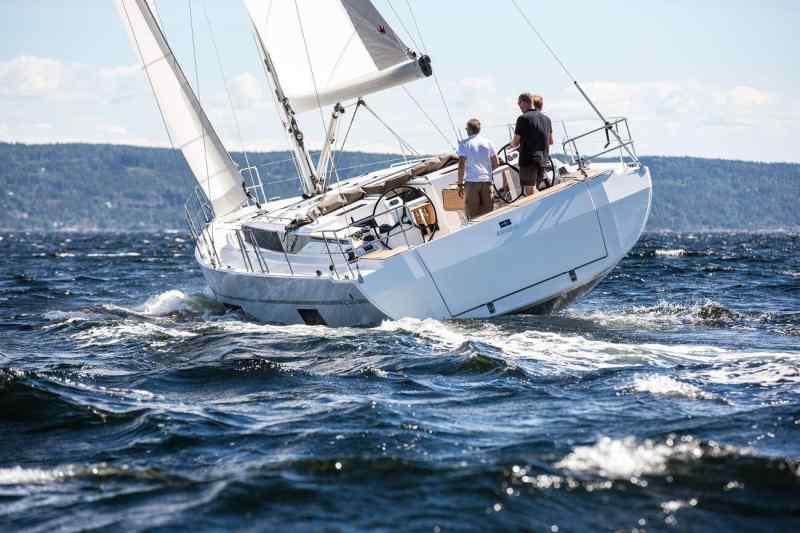
For a total of 330 sailors, windsurfers and kiters - 165 women and 165 men - it is the picturesque bay of Marseille where they want to prove themselves and achieve great things. With daytime temperatures well above 30 degrees, they will be dancing in the cool waters. They want to show what they can do in the heat of battle, play to their strengths and be faster and smarter than the competition.
Quite a few of them will have firmly resolved to do everything as they would in any other regatta, to concentrate on their routines, to remember what they have learnt and to tackle the summit one step at a time. So much for the theory.
But the Olympics is not a normal regatta.
The huge countdown clocks on the starting boats already signalise the XXXL format of the Games. The media attention exceeds the usual manageable number of reporters in international sailing many times over. The desire for success is even greater than usual, because the chance to do so is harder to fight for and rarer to achieve than at the World or European Championships, for example, where many athletes from one nation are allowed to take part. In Olympic sailing, there can only be one boat or board per country and discipline.
The world's biggest sports festival explodes familiar horizons like a kaleidoscope.
Both are of Greek origin: Olympia and the kaleidoscope. Olympia is the Greek town where sporting competitions were held every four years between 776 BC and 393 AD. Not more often, because the athletes of old often had to undertake long journeys to reach Olympia. Although the kaleidoscope was not patented until 1816 by the Scottish physicist David Brewster, it is said to have been known to the ancient Greeks, just like Olympia. Translated from the Greek, kaleidoscope means: to see beautiful shapes.
The essence - to see, experience and achieve beautiful, exciting and great things - connects the Olympics and the kaleidoscope. Athletes who can, embrace the Games. That is easier said than done. Because the pressure on athletes, which they impose on themselves or which comes from outside in the form of expectations, hopes and wishes, is so much higher at the Olympic Games than anywhere else. Goals and willpower are not always compatible with daily form, opportunities and the game of the competition.
Mums, dads, children, friends and fans all over the world will be cheering on the 10,500 Olympians in Paris and the other French host cities. In Germany, fingers are crossed for 463 athletes. Three years ago in Japan, the German Olympic team finished the Games in ninth place in the medals table. The sailors in Enoshima made a remarkably strong contribution to ten gold, eleven silver and 16 bronze medals with one silver for the 49er FX crew Tina Lutz/Susann Beucke (Chiemsee Yacht-Club/NRV) and two bronze medals for the 49er sailors Erik Heil/Thomas Plößel (NRV) and Paul Kohlhoff/Alica Stuhlemmer (KYC). They won the three medals on 3 August within an unforgettable three and a half hours. Erik Heil, who is now working on the promotion of the German team in the SailGP, characterised the picture at the time, saying: "That was a gigantic day for German sailing." It had been 21 years since German medallists had won three medals in sailing at the Games. Especially not in one day.
"The greatest skill was not to think about the medal before the final, because otherwise I can't sail any more because the pressure is simply too great," said helmswoman Tina Lutz after the greatest success of her career in Enoshima.
What will the 14 German sailors, windsurfers and kiters achieve in the Bay of Marseille? Can 2020 world champion Philipp Buhl fulfil his big dream of an Olympic medal at his third attempt in the tight Ilca 7 top flight with at least seven medal contenders? Can iQFoil windsurfing giant Sebastian Kördel return to the form in which he so thrillingly became world champion in 2022 and confirmed his outstanding performance as runner-up in 2023? Can the 470 duo Simon Diesch and Anna Markfort win the medal they have clearly set their sights on in the Olympic mixed premiere and honour the entire German training group that has made them so strong? Can Paul Kohlhoff and Alica Stuhlemmer shine as brightly as they did in Marseille despite the hurdles they had to overcome after losing their coach? What will the other German Olympic novices be capable of in France?
Neither the questions about the medals nor the predictions about performances, coups, comebacks or knockouts can be answered by looking into the Olympic kaleidoscope before the Games of a lifetime. But one thing is certain: the Marseille moments will remain unforgettable for those who made it to the Olympics.
May the words of four-time Olympic champion Paul Elvstrøm accompany them on their Olympic course: "You haven't won a regatta if you've lost the respect of your competitors when you win." In darker hours, the advice of five-time Olympic champion Venus Williams could point the way: "You have to believe in yourself when no one else does. That's what makes you a winner."
I wish the national sailing team a team spirit that carries them and the successes they deserve. I wish the athletes - Philipp, Sebastian, Simon, Anna, Paul, Alica, Jannis, Leonie, Theresa, Marla, Hanna, Julia, Jakob and Andreas - great moments on the water and good encounters on land that they will remember fondly for the rest of their lives. Olympia is also a booster in this respect. "Basti" Kördel put another Olympic feeling into good words: "The special thing about the Games is that you unite the nation behind you a little. Everyone wants you to do well. That's a great feeling."
I wish you, dear YACHT readers, thrilling Olympic sport, fun as you cheer, bravery as you suffer and goosebumps as you rejoice. In our big Olympics special on Yacht online you will find all the information about the team, Marseille, the TV broadcast times, an exciting quiz with a desirable one-off as a prize. And, of course, we will be reporting directly from Marseille every day.
For me as a reporter, this will be the ninth Olympic Games I have covered on site. France's Games will hopefully be peaceful and joyful. They will be different again from Barcelona, Savannah, Sydney, Athens, Qingdao, Weymouth, Rio and Enoshima. I'm just as excited to see the Olympic summit storm again as I was the first time in 1992 in the city that will provide the stage for the America's Cup this autumn: Barcelona.
The Olympic sailing curtain is now opening in Marseille.
Tout est possible à qui rêve, ose, travaille et n'abendonne jamais. Everything is possible to those who dream, dare, work and never give up.
With warm pre-Olympic greetings, yours and yours
Tatjana Pokorny,
YACHT sports expert
Click on it to see through:
The week in pictures


Recommended reading from the editorial team

Malizia 4
First the damage to the foil, now the mainsail has torn

First the damage to the foil, then broken hull reinforcements, and now a tear in the mainsail. Two new videos show how Team Malizia is repairing and further developing the IMOCA ahead of the Route du Rhum.
Silting up of the Elbe
Small ports are fighting for every metre of water depth

The Lower Elbe is silting up, time windows are shrinking and ports are becoming difficult to reach. With flat-bottomed boats and homemade dredgers, sailors are fighting to preserve their fishing grounds.
Propulsion
Max Bianchi variable-pitch propeller, which adjusts its pitch whilst the aircraft is in flight

A variable-pitch propeller that automatically adjusts its pitch whilst in flight: this is what Max Prop’s Max Bianchi model is designed to achieve in powered flight and motor-sailing.
Interview
What is it like to work on board the ‘Thor Heyerdahl’?

The ‘Thor Heyerdahl’ has been sailing the world’s oceans for more than 40 years. YACHT editor Fabian Boerger explains why this historic vessel remains relevant.
Hurricanes 2026
Dramatic rescue off the coast of California – El Niño shapes the storm season

A lifeguard rescues a sailor from a partially flooded yacht off the coast of California. Why the 2026 hurricane season is turning out so differently between the Atlantic and the Pacific.
Blue-water yachts
These five are heading to the ends of the earth

Five blue-water yachts, five designs: the Boréal 56, Kraken 58, Pure 49, Stem 50 and Breehorn 55 demonstrate their strengths and weaknesses on a long-distance voyage.
Record low water level in Lake Zurich
Sailing yacht flown by helicopter to its winter storage facility

Water levels in Lake Zurich are below the previous record low. Because his sailing yacht was stuck in the shallow water and in danger of capsizing, a 65-year-old owner had his boat airlifted out by helicopter. The operation cost around 2,000 francs and highlights just how much the exceptionally low water level is now affecting navigation.
Series of thefts continues
Thieves make off with two 300 PS outboard motors from Wieltsee

Thieves have struck again at Wieltsee: they have stolen two boats and removed heavy outboard motors. This is already the fourth such incident in three months.
Second-hand boat of the week
Arietta 31 – the dawn of an era

A narrow waist, mahogany hull and elegant overhangs: the Arietta 31, designed by Olle Enderlein, prioritises balanced lines and seaworthiness over maximum living space. As a forerunner of later Scandinavian cruising yachts, it is now an interesting classic for sailors seeking a traditional, compact cruising yacht.
Breehorn 55 review
Is it the ideal home at sea?

A pilothouse, teak fittings and an unusually accessible service tunnel: this is how the Breehorn 55 works below deck, and these compromises remain.
Newsletter: YACHT-Woche
Der Yacht Newsletter fasst die wichtigsten Themen der Woche zusammen, alle Top-Themen kompakt und direkt in deiner Mail-Box. Einfach anmelden: