


Dear readers,
For some years now, there have been an increasing number of reports of unpleasant and dangerous encounters between orcas and yachts along the Iberian Peninsula. We have also had several, sometimes very dramatic experience reports published on the subject, it has recently become rather quiet in the media. However, this is not because the animals have calmed down and sailors have been able to sail in and out of the Mediterranean unmolested. It is true that the number of attacks and interactions has decreased slightly. However, this is primarily due to the fact that sailors have joined forces, collected data and provided behavioural tips - in groups on social media, on websites and in apps. However, if a yacht is damaged, it is hardly noticed outside the sailing community. It has simply become a sad normality.
Until now, one of the most important rules of behaviour to avoid an orca encounter has been to stay close to shore in shallow water, beyond the 20-metre depth contour. A look at ship movement charts shows that most sailors follow this advice, even if it means leaving several miles more in the wake, avoiding fishing nets and always keeping an eye on the wind and waves to ensure that they don't end up in a leeward situation. Where sailing close to the coast is not possible, for example when crossing the Bay of Biscay, there is also a more or less pronounced fear. A holiday or a long break is a different experience.
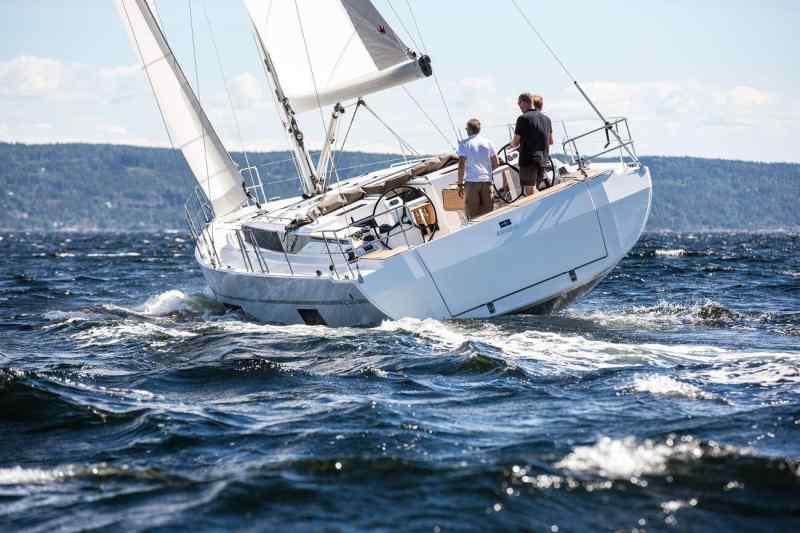
And now this: At the end of June, a Norwegian skipper reported that orcas had attacked his yacht in shallow water. In water only 16 metres deep, they attacked and severely damaged his rudder blade for around 30 minutes until fishing boats finally rushed to his aid. They made fast circles around his boat and drove the killer whales away. The crew escaped unharmed, but sailors in the region took notice. The attack at such a shallow depth means that any remaining safety, which was already based on feet of clay, is crumbling away. Discussions in the forums are hotting up, and the question of whether and how to defend oneself in the event of an attack is quickly being debated once again if it becomes more likely. A question that should not be discussed here.
I wrote about the incident and in the course of this researched how sailors can obtain reliable information about the orca families and their travel routes, about hotspots and possible behaviour in an emergency. There are a few. The British Cruising Association, for example, has set up its own project group that collects and processes data in all forms, from tables and maps with interactions and sightings to field reports. It cooperates with the Grupo Trabajo Orca Atlántica, a Spanish working group dedicated to the protection of marine mammals, which provides similar information. Finally, a third player comes into play with orcas.pt, a privately operated website whose operator Rui Alvez also puts a huge amount of effort into collecting and processing data, communicating daily with members in a messenger group and answering individual questions.
The three players are the most important source of information for sailors, who now have to plan their routes according to possible orca encounters as well as wind, weather and tides. But one problem remains: all three can only be as reliable as the information that is reported to them by sailors and other seafarers or that they find themselves - often by chance - in social media, forums or the local press. The data can therefore be neither congruent nor complete. Sailors get an idea of when and where they may be at risk, but no certainty. And when they come across a family of orcas, they don't know whether they are among the aggressive or the peaceful ones. Much more would be needed for this.
Perhaps the dangerous orcas could be fitted with transmitters so that their movements could be tracked live and encounters avoided - to protect humans and killer whales. Perhaps one day the reason for their behaviour could be found, development forecasts could be made based on this and further measures could be taken. But this requires money, capacity and expertise. And first and foremost, prioritisation by those who make the decisions. As is so often the case, not enough bad things have happened for them to prioritise the issue.
Sailors must therefore continue to work with what they can get. There is still a risk of people or animals coming to harm. The operators of the orca forums, apps and websites do a lot to prevent this. They invest an enormous amount of time and volunteer labour, some to help the sailors, others to protect the marine mammals. But no matter what their motivation is, what they do deserves to be recognised.
Ursula Meer
YACHT editor
Recommended reading from the editorial team

Malizia 4
First the damage to the foil, now the mainsail has torn

First the damage to the foil, then broken hull reinforcements, and now a tear in the mainsail. Two new videos show how Team Malizia is repairing and further developing the IMOCA ahead of the Route du Rhum.
Silting up of the Elbe
Small ports are fighting for every metre of water depth

The Lower Elbe is silting up, time windows are shrinking and ports are becoming difficult to reach. With flat-bottomed boats and homemade dredgers, sailors are fighting to preserve their fishing grounds.
Propulsion
Max Bianchi variable-pitch propeller, which adjusts its pitch whilst the aircraft is in flight

A variable-pitch propeller that automatically adjusts its pitch whilst in flight: this is what Max Prop’s Max Bianchi model is designed to achieve in powered flight and motor-sailing.
Interview
What is it like to work on board the ‘Thor Heyerdahl’?

The ‘Thor Heyerdahl’ has been sailing the world’s oceans for more than 40 years. YACHT editor Fabian Boerger explains why this historic vessel remains relevant.
Hurricanes 2026
Dramatic rescue off the coast of California – El Niño shapes the storm season

A lifeguard rescues a sailor from a partially flooded yacht off the coast of California. Why the 2026 hurricane season is turning out so differently between the Atlantic and the Pacific.
Blue-water yachts
These five are heading to the ends of the earth

Five blue-water yachts, five designs: the Boréal 56, Kraken 58, Pure 49, Stem 50 and Breehorn 55 demonstrate their strengths and weaknesses on a long-distance voyage.
Record low water level in Lake Zurich
Sailing yacht flown by helicopter to its winter storage facility

Water levels in Lake Zurich are below the previous record low. Because his sailing yacht was stuck in the shallow water and in danger of capsizing, a 65-year-old owner had his boat airlifted out by helicopter. The operation cost around 2,000 francs and highlights just how much the exceptionally low water level is now affecting navigation.
Series of thefts continues
Thieves make off with two 300 PS outboard motors from Wieltsee

Thieves have struck again at Wieltsee: they have stolen two boats and removed heavy outboard motors. This is already the fourth such incident in three months.
Second-hand boat of the week
Arietta 31 – the dawn of an era

A narrow waist, mahogany hull and elegant overhangs: the Arietta 31, designed by Olle Enderlein, prioritises balanced lines and seaworthiness over maximum living space. As a forerunner of later Scandinavian cruising yachts, it is now an interesting classic for sailors seeking a traditional, compact cruising yacht.
Breehorn 55 review
Is it the ideal home at sea?

A pilothouse, teak fittings and an unusually accessible service tunnel: this is how the Breehorn 55 works below deck, and these compromises remain.
Newsletter: YACHT-Woche
Der Yacht Newsletter fasst die wichtigsten Themen der Woche zusammen, alle Top-Themen kompakt und direkt in deiner Mail-Box. Einfach anmelden: