


Dear readers,
I've had a truly luxurious week. I've just finished two longer sections as a report on the new Grand Soleil 65 LC, one for YACHT and one for our partner magazine BOOTE Exclusiv. This is a ship with a hull length of a good 20 metres, a width of almost six metres and a weight of 27.5 tonnes, depending on the configuration. A real luxury boat, one would say, chic, fast, elegant and breathtakingly beautiful. And: in the version we sailed, it cost around three million euros, including all the bells and whistles that money can buy.
It's a good thing that people can afford such a magnificent yacht and invest their fortune in the yacht building industry, which is capable of producing such luxury. We live from it and so do many others. As a YACHT editor, I occasionally get the exclusive and exciting opportunity to deal with boats of this type and size as part of my job. In normal life, on the other hand, I belong to the great mass of people who usually don't even come close to such exuberant splendour, let alone ever get on one.
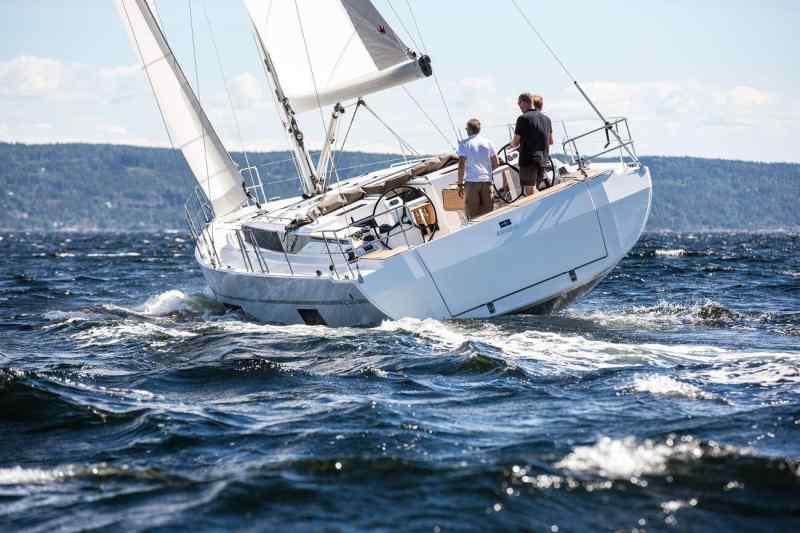
When it comes to buying a sailing boat, we tend to focus on the more modest market segments. Smaller and affordable boats fulfil the desires of a broad range of sailors and those who would like to become sailors. However, the financial possibilities of potential buyers are only of limited importance. Another decisive factor is how the boat is to be used, where it is to be moored and whether a suitable mooring with an appropriate draught is available at all.
The demand for small, manageable and flexible boats is therefore likely to remain high. Boats that are kept at home on the road trailer in the carport and are only put in the water for the weekend or for a summer holiday are also in demand like never before. Anyone who spends a lot of time in marinas can easily understand this development. And there's nothing wrong with that.
There is just one catch: manufacturers currently seem to be neglecting the small market segment. Exciting new launches in the area of small cruisers, trailerable sports boats or compact cruising boats have become rare. And who knows this better than us? Anyone currently interested in a small, handy and affordable boat has less choice in an increasingly dwindling and homogeneous range of new products.
Where, for example, have the affordable and versatile small cruisers from Polish production gone, which ten years ago made life difficult for the established series manufacturers with their attractive and inexpensive concepts and filled the space at international trade fairs? Some of these ships are still available and can be bought new, but they have also become expensive in comparison. In addition, there is hardly any new development in this area either. The range is therefore shrinking noticeably. And the small cruisers are also only sparsely represented at the trade fairs, if at all.
If you ask the manufacturers, you always get the same answer: It is simply no longer worth developing and offering small boats. Planning, design and, not least, mould construction are cost-intensive, and the investment cannot be fully amortised through sales. This is understandable in a difficult economic period in which the prices for the materials used to manufacture boats are rising, shipyard sales are plummeting and dealers' margins are close to zero. In short, there is hardly any money to be made from building and selling small boats at the moment.
Nevertheless, there is a glimmer of sunshine on the gloomy horizon. In spring, high-volume manufacturer Jeanneau launched the Sun Odyssey 350 once again presented an interesting boat for the highly sought-after entry-level class around ten metres hull length, Sunbeam Yachts in Austria has launched the 29.1 new innovative daysailer at the start, and just these days my colleague Fridtjof Gunkel is a guest at Hanse Yachts in Greifswald to present the brand new 360 to test.
Ultimately, these are significant signs that there could be more movement in the market. However, it remains to be seen whether this could be the start of a turnaround in the development of small boats. It would certainly be desirable. I am very curious.
Michael Good,
YACHT editor
Click on it to see through:
The week in pictures


Recommended reading from the editorial team

Malizia 4
First the damage to the foil, now the mainsail has torn

First the damage to the foil, then broken hull reinforcements, and now a tear in the mainsail. Two new videos show how Team Malizia is repairing and further developing the IMOCA ahead of the Route du Rhum.
Silting up of the Elbe
Small ports are fighting for every metre of water depth

The Lower Elbe is silting up, time windows are shrinking and ports are becoming difficult to reach. With flat-bottomed boats and homemade dredgers, sailors are fighting to preserve their fishing grounds.
Propulsion
Max Bianchi variable-pitch propeller, which adjusts its pitch whilst the aircraft is in flight

A variable-pitch propeller that automatically adjusts its pitch whilst in flight: this is what Max Prop’s Max Bianchi model is designed to achieve in powered flight and motor-sailing.
Interview
What is it like to work on board the ‘Thor Heyerdahl’?

The ‘Thor Heyerdahl’ has been sailing the world’s oceans for more than 40 years. YACHT editor Fabian Boerger explains why this historic vessel remains relevant.
Hurricanes 2026
Dramatic rescue off the coast of California – El Niño shapes the storm season

A lifeguard rescues a sailor from a partially flooded yacht off the coast of California. Why the 2026 hurricane season is turning out so differently between the Atlantic and the Pacific.
Blue-water yachts
These five are heading to the ends of the earth

Five blue-water yachts, five designs: the Boréal 56, Kraken 58, Pure 49, Stem 50 and Breehorn 55 demonstrate their strengths and weaknesses on a long-distance voyage.
Record low water level in Lake Zurich
Sailing yacht flown by helicopter to its winter storage facility

Water levels in Lake Zurich are below the previous record low. Because his sailing yacht was stuck in the shallow water and in danger of capsizing, a 65-year-old owner had his boat airlifted out by helicopter. The operation cost around 2,000 francs and highlights just how much the exceptionally low water level is now affecting navigation.
Series of thefts continues
Thieves make off with two 300 PS outboard motors from Wieltsee

Thieves have struck again at Wieltsee: they have stolen two boats and removed heavy outboard motors. This is already the fourth such incident in three months.
Second-hand boat of the week
Arietta 31 – the dawn of an era

A narrow waist, mahogany hull and elegant overhangs: the Arietta 31, designed by Olle Enderlein, prioritises balanced lines and seaworthiness over maximum living space. As a forerunner of later Scandinavian cruising yachts, it is now an interesting classic for sailors seeking a traditional, compact cruising yacht.
Breehorn 55 review
Is it the ideal home at sea?

A pilothouse, teak fittings and an unusually accessible service tunnel: this is how the Breehorn 55 works below deck, and these compromises remain.
Newsletter: YACHT-Woche
Der Yacht Newsletter fasst die wichtigsten Themen der Woche zusammen, alle Top-Themen kompakt und direkt in deiner Mail-Box. Einfach anmelden: