Dear readers,
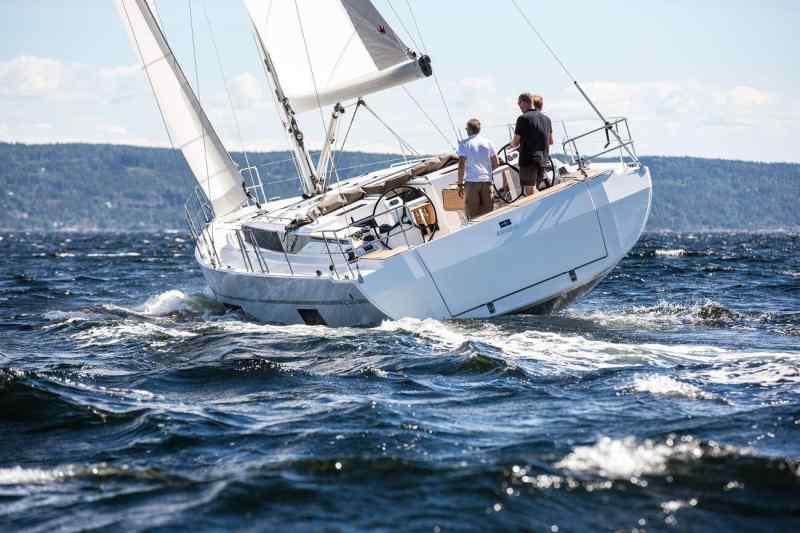
It's a quiet development in the yacht industry: shipyards, designers and builders are pushing the performance limits of their production touring yachts ever higher. Where elegance, cosiness and good-natured sailing characteristics were perhaps more important in the past, hull speed, sail area optimisation and hydrodynamic subtleties are increasingly coming into focus. Shipyards are investing heavily in the development of modern hulls, high-performance rig concepts and weight-saving construction methods - and not just for high-end racing yachts, but also specifically in the area of boats for the broad base of cruising sailors.
The approach is understandable: The need for speed in cruising sailing probably has more facets than you might think at first glance. If you can sail faster, you can reach your destination earlier, plan a diversion to the most beautiful anchorage or escape the impending weather window more quickly - for example. However, modern hull shapes not only offer more speed, but also stable sailing characteristics, better control and, above all, more safety - characteristics that sailors like to count on. And last but not least: sailing fast is simply more fun.
In addition, yachts with a higher performance capacity generally attract more interest from buyers. For many, it's like a car: performance is sexy, even if you don't necessarily always have to or want to utilise its potential. On a cosy family cruise on the Baltic Sea, the broad collective of touring sailors is unlikely to care whether you make progress at half a knot more or less. Rather, the journey is the goal.
The hunt for more performance also has its downsides. The modern, often more radical lines break with the classic ideal of beauty. Instead of long, elegant overhangs, harmonious shapes and soft transitions, aggressive-looking designs with an often almost threatening appearance set the tone today. What used to come across as a gently curved piece of maritime elegance now often looks as if it is about to become the Vendée Globe or - as is currently the case - the The Ocean Race Europe across the world's oceans. Anyone who falls in love with a boat for emotional reasons - and hopefully quite a few people do - will feel alienated here.
So why the urge? Part of the answer is probably to be found in the competition. In a tight market, any measurable improvement is always a good selling point. Sporty sailing characteristics and high performance potential are also undisputed seals of quality when assessing a cruising yacht - even if they are less important to the future owner in everyday life. What's more, anyone who buys a boat wants to feel that they are at the cutting edge of technology. There's nothing wrong with that - quite the opposite.
Nevertheless, you have to keep in mind what cruising is really about. It is about consciously slowing down in a world that is constantly accelerating. It is the art of savouring and enjoying the moment. It's the quiet moments in the evening light, the play of the waves on the bow, the smell of salt and wind. The most beautiful sailing does not necessarily come from the pursuit of maximum performance, speed and sportiness, but often in the balance of comfort, safety, enjoyment and - yes - aesthetics. Moving fast can be a means to an end, but it is rarely the end itself.
Performance has its place in sailing, no question about it. But if it becomes the driving force behind every design decision, the touring yacht also loses a piece of its soul.
Michael Good
YACHT editor
You have voted - the results of last week's poll:
Recommended reading from the editorial team

Malizia 4
First the damage to the foil, now the mainsail has torn

First the damage to the foil, then broken hull reinforcements, and now a tear in the mainsail. Two new videos show how Team Malizia is repairing and further developing the IMOCA ahead of the Route du Rhum.
Silting up of the Elbe
Small ports are fighting for every metre of water depth

The Lower Elbe is silting up, time windows are shrinking and ports are becoming difficult to reach. With flat-bottomed boats and homemade dredgers, sailors are fighting to preserve their fishing grounds.
Propulsion
Max Bianchi variable-pitch propeller, which adjusts its pitch whilst the aircraft is in flight

A variable-pitch propeller that automatically adjusts its pitch whilst in flight: this is what Max Prop’s Max Bianchi model is designed to achieve in powered flight and motor-sailing.
Interview
What is it like to work on board the ‘Thor Heyerdahl’?

The ‘Thor Heyerdahl’ has been sailing the world’s oceans for more than 40 years. YACHT editor Fabian Boerger explains why this historic vessel remains relevant.
Hurricanes 2026
Dramatic rescue off the coast of California – El Niño shapes the storm season

A lifeguard rescues a sailor from a partially flooded yacht off the coast of California. Why the 2026 hurricane season is turning out so differently between the Atlantic and the Pacific.
Blue-water yachts
These five are heading to the ends of the earth

Five blue-water yachts, five designs: the Boréal 56, Kraken 58, Pure 49, Stem 50 and Breehorn 55 demonstrate their strengths and weaknesses on a long-distance voyage.
Record low water level in Lake Zurich
Sailing yacht flown by helicopter to its winter storage facility

Water levels in Lake Zurich are below the previous record low. Because his sailing yacht was stuck in the shallow water and in danger of capsizing, a 65-year-old owner had his boat airlifted out by helicopter. The operation cost around 2,000 francs and highlights just how much the exceptionally low water level is now affecting navigation.
Series of thefts continues
Thieves make off with two 300 PS outboard motors from Wieltsee

Thieves have struck again at Wieltsee: they have stolen two boats and removed heavy outboard motors. This is already the fourth such incident in three months.
Second-hand boat of the week
Arietta 31 – the dawn of an era

A narrow waist, mahogany hull and elegant overhangs: the Arietta 31, designed by Olle Enderlein, prioritises balanced lines and seaworthiness over maximum living space. As a forerunner of later Scandinavian cruising yachts, it is now an interesting classic for sailors seeking a traditional, compact cruising yacht.
Breehorn 55 review
Is it the ideal home at sea?

A pilothouse, teak fittings and an unusually accessible service tunnel: this is how the Breehorn 55 works below deck, and these compromises remain.
Newsletter: YACHT-Woche
Der Yacht Newsletter fasst die wichtigsten Themen der Woche zusammen, alle Top-Themen kompakt und direkt in deiner Mail-Box. Einfach anmelden: