


Dear readers,
The international climate conference is currently taking place in Azerbaijan. For a fortnight, thousands of delegates from all over the world are negotiating in the capital Baku on how to proceed with environmental and climate protection. However, the high-level conference is taking place under difficult circumstances. After all, it is well known that the global climate is not in good shape.
New and worrying facts also paint a bleak picture: from January to September 2024 alone, the global average temperature was 1.54 degrees above pre-industrial levels. A sad record, as the World Meteorological Organisation reports. And: 2024 is expected to be the warmest year since records began. Donald Trump's victory in the US presidential election also casts a shadow over the climate conference. Ambitious climate protection on the part of the USA is not to be expected in the coming years. On the contrary: Trump has already announced his intention to withdraw from the Paris Climate Agreement once he takes office. So the red alert is on. Anyone who still doubts this is deaf in both ears and blind in both eyes.
In order to limit global warming to 1.5 degrees Celsius compared to pre-industrial levels, as stipulated in the Paris Agreement, greenhouse gas emissions must be reduced by at least 40 per cent by 2030 and to zero by 2050, say climate experts. Effective and far-reaching measures are needed now. And everyone is equally challenged: Business, industry, politics and society.
Today, the yacht building industry is also facing the challenge of making the production and operation of yachts more environmentally friendly and sustainable. The maritime sector contributes significantly to CO2 emissions, whether through the operation of yachts with fossil fuels or through the construction of boats from materials whose production and disposal can also harm the environment.
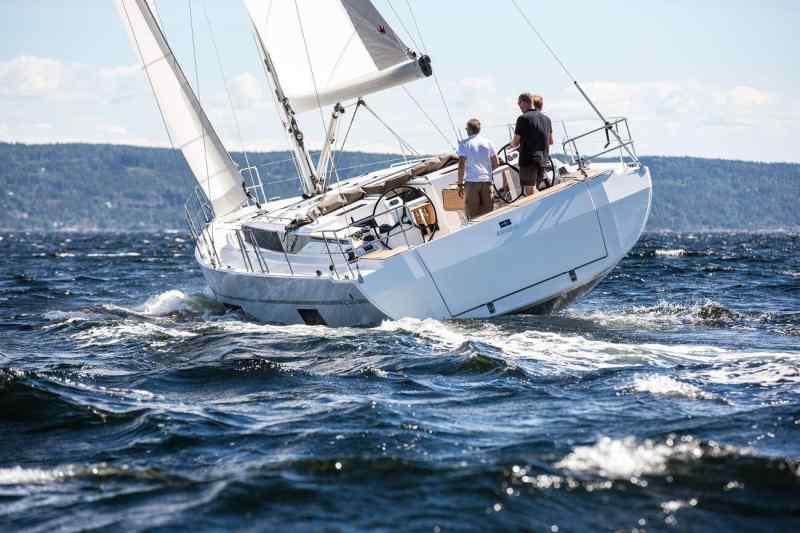
The good news is that there are already many innovative approaches and technologies in the yacht building industry to further reduce the industry's ecological footprint. One important step is the switch to emission-free drives such as electric motors or hybrid systems. The use of alternative fuels such as hydrogen and the development of solar-powered yachts are also becoming increasingly important. In addition, the use of sustainable materials such as recycled aluminium or biodegradable and reusable plastic compounds is becoming increasingly important in yacht construction.
Manufacturers can also have a positive influence on the design, e.g. by developing fast and powerful sailing boats that allow you to sail longer and more efficiently without an engine, even in light winds. Sailing power and performance are therefore also topics that can and are being strongly promoted, and not just for reasons of sportiness and regatta success.
The other side of the coin: greenwashing! Some manufacturers and suppliers only like sustainability as a marketing tool, without really taking any in-depth measures. There is a lot of talk about "green" innovations, but these are often just cosmetic measures that shipyards and brands use to polish up their image.
We will see whether the yacht building industry is really in a position to bring about ecological change in the long term. Or whether sustainability in this industry is perhaps just a trend that sells well but has little effect. In the end, this area of tension will show how seriously the industry takes its responsibility towards the environment.
Michael Good
YACHT editor
Click on it to see through:
The week in pictures


Recommended reading from the editorial team

Vendée Globe
The race in the live tracker

The live tracker of the Vendée Globe 2024/25: This tracking shows the race of the tenth edition of the round-the-world regatta - with Boris Herrmann!
Malizia 4
First the damage to the foil, now the mainsail has torn

First the damage to the foil, then broken hull reinforcements, and now a tear in the mainsail. Two new videos show how Team Malizia is repairing and further developing the IMOCA ahead of the Route du Rhum.
Silting up of the Elbe
Small ports are fighting for every metre of water depth

The Lower Elbe is silting up, time windows are shrinking and ports are becoming difficult to reach. With flat-bottomed boats and homemade dredgers, sailors are fighting to preserve their fishing grounds.
Propulsion
Max Bianchi variable-pitch propeller, which adjusts its pitch whilst the aircraft is in flight

A variable-pitch propeller that automatically adjusts its pitch whilst in flight: this is what Max Prop’s Max Bianchi model is designed to achieve in powered flight and motor-sailing.
Interview
What is it like to work on board the ‘Thor Heyerdahl’?

The ‘Thor Heyerdahl’ has been sailing the world’s oceans for more than 40 years. YACHT editor Fabian Boerger explains why this historic vessel remains relevant.
Hurricanes 2026
Dramatic rescue off the coast of California – El Niño shapes the storm season

A lifeguard rescues a sailor from a partially flooded yacht off the coast of California. Why the 2026 hurricane season is turning out so differently between the Atlantic and the Pacific.
Blue-water yachts
These five are heading to the ends of the earth

Five blue-water yachts, five designs: the Boréal 56, Kraken 58, Pure 49, Stem 50 and Breehorn 55 demonstrate their strengths and weaknesses on a long-distance voyage.
Record low water level in Lake Zurich
Sailing yacht flown by helicopter to its winter storage facility

Water levels in Lake Zurich are below the previous record low. Because his sailing yacht was stuck in the shallow water and in danger of capsizing, a 65-year-old owner had his boat airlifted out by helicopter. The operation cost around 2,000 francs and highlights just how much the exceptionally low water level is now affecting navigation.
Series of thefts continues
Thieves make off with two 300 PS outboard motors from Wieltsee

Thieves have struck again at Wieltsee: they have stolen two boats and removed heavy outboard motors. This is already the fourth such incident in three months.
Second-hand boat of the week
Arietta 31 – the dawn of an era

A narrow waist, mahogany hull and elegant overhangs: the Arietta 31, designed by Olle Enderlein, prioritises balanced lines and seaworthiness over maximum living space. As a forerunner of later Scandinavian cruising yachts, it is now an interesting classic for sailors seeking a traditional, compact cruising yacht.
Breehorn 55 review
Is it the ideal home at sea?

A pilothouse, teak fittings and an unusually accessible service tunnel: this is how the Breehorn 55 works below deck, and these compromises remain.
Newsletter: YACHT-Woche
Der Yacht Newsletter fasst die wichtigsten Themen der Woche zusammen, alle Top-Themen kompakt und direkt in deiner Mail-Box. Einfach anmelden: