


Dear readers,
The wind whistles from the left; howling engine noises are drowned out by loud shouts and clattering halyards on the mast. With strong gusts from astern, a skipper in a pit lane tries to get his yacht under control. He overestimates his speed and forgets how much the aft wind is pushing, misses the targeted pit several times and provides all the yacht crews moored in the pits with a really exciting harbour cinema by frantically operating his engine.
While the yacht moves forwards, sideways and then backwards again, a crew member stands on the foredeck trying to point the skipper in the right direction with loud instructions. The wind picks up and the attempts to catch a box at the end of the pit lane seem hopeless and countless.
There are also countless people ready to help on the jetty.
Everyone has a tip, an opinion, the view that they can do it better and a shake of the head.
Do you recognise yourself? As a good jetty neighbour, you can certainly report similar situations. You want to help other water sports enthusiasts moor up in a friendly manner, but they often don't have their yachts under control, whether it's when the sailing weather is "Lieschen-Müller" or - and this is understandable - when the weather starts to blow.
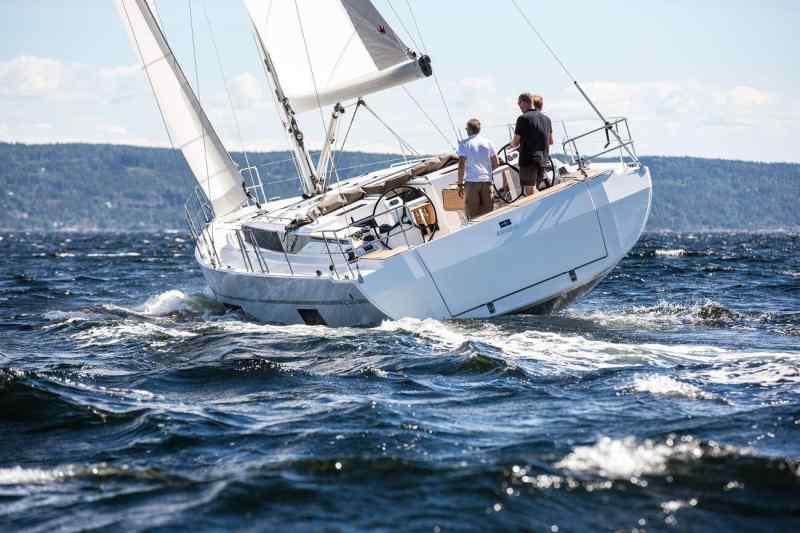
Everyone who moves a yacht comes to the point where it gets uncomfortable and you ask yourself how you can manage a good manoeuvre without loud words, with clean yacht handling and a happy crew at the end of the trip.
How can I say this without coming across as a smart aleck or a do-gooder... good and timely preparation as well as calm and clear communication with the crew are half the battle. Shouting and loud grumbling on board are not very helpful and don't necessarily leave the best impression - especially not with your new neighbours on the dock.
What also helps is the deployment of appropriately sized fenders at the right height for the size of the yacht and a cleanly rigged line that is well cast and can also be fitted with an eye if it is not to lie on a slip.
Anyone who rushes to the aid of an incoming yacht crew in a dicey situation will be pleased if 15 metres of unshot line don't fly around their ears while they are trying to keep the pulpit off the jetty at the same time.
Timing plays an important role in all these preparations. Once the yacht is in the box, it is too late for the stern line and fenders.
What's going on on board? In addition to dwindling values in society, have we now also forgotten how to behave on board?
Things like rattling halyards in the harbour, squeaking and jerking lines when yachts are tied up too tightly, permanently standing National even with an absent crew, mooring lines that hang so ruthlessly over your own lines that you seriously consider taking a knife to the tangle, dirty fenders that rub against your own outer skin that you have painstakingly polished up in winter storage.
All this sometimes leaves me a little speechless - just as speechless as the moment when I, as the last remaining future neighbour of the restless yacht on the jetty, was thrown that wet, heavy ball of line that almost swept me off the jetty.
Does it have to be? Sure, stressful moments on board are not necessarily great moments for most of us water sports enthusiasts, but wouldn't it be better to pause for a moment and think about how to calmly carry the emotional wave ashore without upsetting other people?
Sometimes I wish there was some kind of behavioural MOT on board or stricter instruction in sailing etiquette, or at least the opportunity to vent my displeasure about poor boat handling and lack of respectful interaction with other sailors. Herewith done.
Thea Kohlhoff,
YACHT author
Click on it to see through:
The week in pictures


Recommended reading from the editorial team

Malizia 4
First the damage to the foil, now the mainsail has torn

First the damage to the foil, then broken hull reinforcements, and now a tear in the mainsail. Two new videos show how Team Malizia is repairing and further developing the IMOCA ahead of the Route du Rhum.
Silting up of the Elbe
Small ports are fighting for every metre of water depth

The Lower Elbe is silting up, time windows are shrinking and ports are becoming difficult to reach. With flat-bottomed boats and homemade dredgers, sailors are fighting to preserve their fishing grounds.
Propulsion
Max Bianchi variable-pitch propeller, which adjusts its pitch whilst the aircraft is in flight

A variable-pitch propeller that automatically adjusts its pitch whilst in flight: this is what Max Prop’s Max Bianchi model is designed to achieve in powered flight and motor-sailing.
Interview
What is it like to work on board the ‘Thor Heyerdahl’?

The ‘Thor Heyerdahl’ has been sailing the world’s oceans for more than 40 years. YACHT editor Fabian Boerger explains why this historic vessel remains relevant.
Hurricanes 2026
Dramatic rescue off the coast of California – El Niño shapes the storm season

A lifeguard rescues a sailor from a partially flooded yacht off the coast of California. Why the 2026 hurricane season is turning out so differently between the Atlantic and the Pacific.
Blue-water yachts
These five are heading to the ends of the earth

Five blue-water yachts, five designs: the Boréal 56, Kraken 58, Pure 49, Stem 50 and Breehorn 55 demonstrate their strengths and weaknesses on a long-distance voyage.
Record low water level in Lake Zurich
Sailing yacht flown by helicopter to its winter storage facility

Water levels in Lake Zurich are below the previous record low. Because his sailing yacht was stuck in the shallow water and in danger of capsizing, a 65-year-old owner had his boat airlifted out by helicopter. The operation cost around 2,000 francs and highlights just how much the exceptionally low water level is now affecting navigation.
Series of thefts continues
Thieves make off with two 300 PS outboard motors from Wieltsee

Thieves have struck again at Wieltsee: they have stolen two boats and removed heavy outboard motors. This is already the fourth such incident in three months.
Second-hand boat of the week
Arietta 31 – the dawn of an era

A narrow waist, mahogany hull and elegant overhangs: the Arietta 31, designed by Olle Enderlein, prioritises balanced lines and seaworthiness over maximum living space. As a forerunner of later Scandinavian cruising yachts, it is now an interesting classic for sailors seeking a traditional, compact cruising yacht.
Breehorn 55 review
Is it the ideal home at sea?

A pilothouse, teak fittings and an unusually accessible service tunnel: this is how the Breehorn 55 works below deck, and these compromises remain.
Newsletter: YACHT-Woche
Der Yacht Newsletter fasst die wichtigsten Themen der Woche zusammen, alle Top-Themen kompakt und direkt in deiner Mail-Box. Einfach anmelden: