


In 40 knots of wind with strong gusts and rain, a sailing yacht ran aground and stranded between the Weser and Elbe rivers on Thursday night. The skipper was able to make an emergency call at around 9 p.m., after which the connection to the stranded vessel was initially lost. The "Weser Traffic" area control centre was able to determine a bearing line on which it assumed the yacht was located: the stranded ship was in the notorious Nordergründe.
The sea rescuers from Hooksiel and Horumersiel set out to search. The yacht had no AIS. Radio contact with the stranded vessel was only re-established 15 minutes before they reached the distressed vessel. On the other side of the shallow water area, the federal police also took part in the search and deployed a dinghy. However, the stranded ship was initially not visible in the three metre high surf.

A daughter boat of the sea rescuers followed the bearing line across the Nordergründe and finally discovered the yacht's top light. "Under the most difficult conditions", according to the sea rescuers, they managed to rescue the young couple and their small dog. The daughter boat ran aground several times. The crew of the ship were taken to Hooksiel and from there temporarily to hospital. The ten-metre yacht had to be abandoned and was washed up southwest of Neuwerk. The sea rescuers have since been able to secure it to prevent it from drifting into the shipping lane. It will probably not be possible to salvage it until the weather improves.
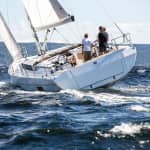
Given the dramatic situation, the sailors were extraordinarily lucky. It is not known why or where they were travelling between the Elbe and Weser rivers in the extremely adverse conditions. "The Nordergründe are a very difficult and dangerous area," says North Sea expert and author Holger Peterson. "Many people want to take a shortcut here on their way between the Elbe and Weser. But even with little wind, they are choppy, and high, steep waves build up in strong winds. You have no view of land and may think you are already in deep water. Some places are only two and a half metres deep - you can quickly run aground in the wave trough," explains Peterson. His recommendation: If you are surprised by strong winds, you should sail around the outside of the bow to a water depth of 15 metres. "That only takes an hour longer and is much safer," says Peterson.
Thursday's serious accident is already the second on the North Sea coast at the start of the season. The German sailing yacht that sank three weeks ago probably also wanted to take a shortcut. ran aground off Terschelling is. After a water ingress, the crew had to quickly abandon their ship and transfer to a life raft. They were rescued in less than an hour, not least because they had activated an EPIRB.

Both cases show that careful navigation is essential in the tidal area with its many shifting sandbanks and that even experienced sailors can find themselves in dangerous situations in the near-shore area from as little as 5 Beaufort. In an emergency at sea, a quick radio message is crucial. Every recreational skipper should always test the radio system at the start of the season and have the radio emergency scheme ready in case of an emergency at sea. You can download it free of charge download here.

Being found quickly can be vital for survival. Smoke pots, hand torches and distress flares therefore belong on every yacht, as well as a powerful torch, because "if the sail or mast is illuminated, it makes searching in the dark much easier," says Antke Reemts from the sea rescue organisation. "Of course, active AIS and an active radar reflector, which should be standard equipment on sailing yachts, are much better."
Downloads:

Ursula Meer
Redakteurin Panorama und Reise
