


A storm with gale-force winds is battering England's east coast. Seven regatta yachts from the North Sea Week Edinburgh Regatta are still at sea. Four of the yachts have changed course towards the coast. Two yachts have crossed the finish line, all others have abandoned the regatta in good time.
"The storm depression will have reached the sea area off Edinburgh by the evening today." Meeno Schrader, sailing weather professional from Wetterwelt, had provided an accurate forecast. "The wind field has an average wind speed of 35 knots from 340 degrees, the gusts can go over 50 knots."
The wind is aggravated by the tidal current. The outgoing water will lead to short, breaking waves, the height of which can exceed eight metres. The English coast offers no protection in this wind direction. The water and air are six to eight degrees cold. "The slower ships should seek shelter in Newcastle," says Schrader.
At the entrance to the Firth of Forth, the yachts come into a leeward wall situation, which poses a serious danger in wind forces of 10 and a breaking current wave.

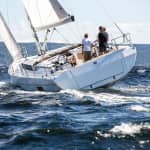
"The spook will be over by midday tomorrow," says Meeno Schrader, "the Swan 'Charisma' has chosen a clever course, they've already had the strongest wind and will be able to sail to Edinburgh tomorrow with sunshine and an easterly wind, later a north-easterly wind under spinnaker." The northbound leg of the Charisma was certainly not a walk in the park; the shifting winds undoubtedly caused an unpleasant cross sea. The 44-foot Swan has already overcome gusts of over 30 knots.
The "Pogo 2" (GER 6003) skippered by Michael Mühlmann has cancelled the regatta due to the weather conditions and the crew will probably head for Bligh. Markus Seebich from Sailing Island in Mönchengladbach: "I've just spoken to Michael on the 'Pogo 2' on the phone again: Everything on board is so far under control. The wind is currently over 40 knots, gusting up to 50 knots. Sea: 4 to 5 metres. Three crew members are seasick. One crew member may have bruised ribs." The "Pogo 2" is currently sailing under reefed jib at a speed of around nine knots. The distance to the harbour of Blyth is 25 nautical miles.
The sister ship "Pogo 1" (GER 6002) is so close to the mouth of the Firth of Forth that it could soon get some cover. According to the grip data, slightly less wind is expected under land.
The "Magic" (GER 6492) of the Well Sailing yacht school was at 55.57° N, 4.47° W at 3.00 pm, only 30 nautical miles to the Firth of Forth. The race tracker seems to have been faulty since midnight. This means that the "Magic" should be the third yacht to moor in Edinburgh.
Skipper Jan Hamester from on board the Frers 51 "Magic": "According to the circumstances, everything looks fine. All the plates are broken - and broken glass is good luck. We have gusts up to 36 knots, right now we have 25 to 32 knots of constant wind. A total of 40 miles to Edinburgh, we should arrive with the tide out."
The "Dicke Bank", a Victorie 1200, is safely moored in Newcastle. At midnight on the night of the 22nd to the 23rd, the crew received a weather report on VHF shortwave: 9 Beaufort from the north-west, with the risk of hurricane-like gusts. At this point, four of the six crew members on board the twelve metre long, very seaworthy yacht were seasick, but still fit for action. Despite this, the crew fought their way through the rough seas and constant 30-knot winds with great motivation.
"We were in a very good position at the time, all the boats that we could locate via AIS should have paid us." Wolfgang Doczyck, skipper of the "Dicke Bank", is an experienced sailor. "None of us had ever done such a tough tour before. It was very cold. The breakers were constantly washing over the deck. At some point, the oilskins got wet on the inside. The water creeps up your arms. And it didn't get warm in the bunk either."

When the new weather forecast came in, the six of them agreed: "If we continue sailing, we are taking a risk that is no longer calculable." Doczyck does sound a little sad on the phone; his ship is particularly fast when there is a lot of wind at the cross. When he hears the latest weather forecast from Meeno Schrader, he is relieved: "We've made the right decision. Maybe we'll hire a car and drive to Edinburgh. We still have a few days' holiday left."
The approach to Newcastle was completely unproblematic; sails can be easily stowed in the shelter of the large outer harbour. "Newcastle is an ideal harbour of refuge, you can come in here in any weather," says Doczyck. "And it's safe to moor here too."
The Elan 40 "Röde Orm" has found shelter in Sunderland on the east coast of England. Everyone is safe and sound. The race tracker had failed, so many family and friends were worried, and the race organisers received a flurry of calls.
"First we had a broken lever on the fore hatch, a lot of water came into the foredeck and we had to bail. A leak plug in the lever hole was the solution." Elmar Vogel, skipper of the "Röde Orm", is in a good mood despite the task. "Later, when we were changing the sails, we realised that three cardeels were broken in the lower shroud. That's why we stopped tacking, took away the jib first, then the main and motored to Sunderland under trysail as stabilisation. We didn't want to sail into a storm with a weakened rig."
The crew is now removing the lower shrouds in order to have new shrouds pressed by a rig builder near Newcastle. In Sunderland, "Röde Orm" is well protected from the approaching storm that night.
Jens Kohfahl, winner of the 2012 Skagen Round, has been back on Heligoland with his storm-tested Nicholson 31 "Tramontane" since Thursday morning. "We were berthed on the Dogger Bank for six hours, recovered, slept a bit and hoped for an improvement in the weather. I've never experienced anything like it. With the third reef and storm jib, we fell extremely hard into the wave troughs, even though our long-keeler is so good-natured." With the long keeler, which is rather slow at the cross, the crew would have had to sail through the coming storm at full speed.
