


Tips for buying a used boat: Five used yachts compared: sailing characteristics

Boat tests are to sailors what a box of chocolates is to Forrest Gump: you never really know what you're going to get. This is especially true for used boat tests. Is it the owner's jewel - well maintained and in top condition - or a workhorse that needs to go after a long and strenuous charter life? Or is it even a community of heirs that wants to get rid of the boat, to which there is no longer any connection, and sees the test as a free advertising measure?
Used boats in the 30-foot class in comparison
Just like a potential buyer, the testers also approach the object. And in this comparison, the test subjects were quite heterogeneous. The Winner had been used intensively by the owner and should now quickly find a new owner before major investments are due; these are the responsibility of the buyer. In terms of sailing, she briefly but convincingly showed what she is capable of, despite the fact that the cloths are no longer new.
5 used boats show whether they still have what it takes under sail
The X-342 had quite good laminate sails on it, and the engine had already been renewed. Nevertheless, a great deal of work and investment is required, for example in upholstery and deck hardware.
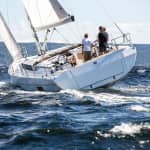
The Dufour was ready to go. There wasn't much equipment on board anyway; what was there worked. New sails were due, otherwise the Frenchwoman was doing well.
Investments were made in parts of the Dehler, but a common thread was not recognisable in the renovation attempts. Expenditure is also planned for her, for example in the areas of electrics and navigation.

The most striking example was the Bavaria. Inside, it looked really good and had probably already had new upholstery. On deck, however, it was a picture of devastation. The new owner will have to invest heavily to get it up to an adequate standard.
Off to the water
On the test day, the wind is blowing at around 18 knots - ideal conditions for testing the boats at or above their reefing limit. This is because old used boats are not spared any more than their brand-new counterparts.
Dufour, Bavaria and Dehler compete with full sails, X and Winner start reefed. As expected, the Dufour, the shortest boat in the test, is the slowest. The crew doesn't care - the boat is simply fun. If there were a little more trim options on board, it would be easy to continue sailing with a full sail without the annoyance of sun shots.
Charterers love them
The Bavaria parries all gusts with the rudder. Sun shot? Not in 18 knots of wind. And that despite sails that are so blown out that they cause 10 degrees more heel than would be healthy. That certainly works. Probably one of the reasons why the little one is so popular with charterers.

Although the Dehler does not provide the precise steering feel that it offers with a tiller, it sails well in a convoy. She is simply a very fast boat. With her long keel, she also wants to go upwind quite a bit.
At the top of the field, X and Winner are in a neck-and-neck race. Of course, the X should be ahead in terms of vital statistics - and it is. The advantage of the Winner, however, is the unspectacular retrievability of its good speed. Going up and being fast, of course, with a little knowledge of trim, that also works with a small crew.
Not so with the X, it is a complicated boat. Backstays and checkstays plus backstay, everything can be trimmed and adjusted - the crew and skipper have to know what they are doing. If they do, the X is a real fun machine, but not for everyone. Each boat has its own character. You have the choice for under 40,000 euros.
The powerhouse: Bavaria 30

One bug works better than the other. This is not unusual, but was very pronounced during the test. The reason is the mainsheet: The sail can simply be pulled further into the centre on starboard. On a hectic handover day at the charter base, where the Bavaria had been employed for 13 years, a block was quickly fitted when the original from Rutgerson failed. As a result, one part is missing and the sheet lacks traction. Most customers will not have noticed this, but the testers certainly did.
But even without this defect, the little Franconian would not be a racing yacht. With a lot of wetted surface and completely worn sails, it is heavy and doesn't have the best chances. The 30 is known for getting stuck at the stern, which was also the case in the test. Weight aft is therefore poison. Otherwise, it doesn't feel too bad despite the poor starting conditions.

The older Bavarias run somehow and give a very good feeling thanks to the rudder pressure. With fresh cloths and new fittings here and there, the Bavaria would also be a pleasure to sail. When it comes to fittings, the 30 benefits from the common parts strategy. The stopper, for example, which is too small on the 37, fits perfectly here.
As is typical for Bavaria, the mainsheet is run on the superstructure; this can be a problem for the usually small crew. However, it is possible to convert to an aft-facing solution with two stoppers.

After 13 years in charter, the deck is a building site. The fittings need to be maintained or replaced and the gelcoat repaired. However, some of this can be done by yourself.
Model history and market situation: The Bavaria 30 was a popular model, offered with a draught of 1.45 or 1.85 metres. From the charter with building sites from 30,000 euros. Maintained by the owner, prices go up to 45,000 euros. Strong demand.
Model evolution: Duetta 94/Dehler 31

The steering wheel is one such example. Already several years old, the Duetta is doing well on the market. But the competition offers the steering wheel from 30 feet upwards. Dehler has to keep up so as not to lose market share.
So the Whitlock pillar is offered as an option, and some owners even retrofit it. However, the cockpit is not designed for this - it is too narrow, because everything has to fit behind the traveller, and not rigid enough.
The result: the pillar wobbles, the helmsman has hardly any room and finds it difficult to reach the mainsheet. Yet the Dehler with tiller sails excellently. The space on the coaming is comfortable and all the necessary lines are within easy reach.

In addition, the rudder bearing on the test boat, as on all the test boats, is worn out and the autopilot takes away any sensitivity from the steering. As proven in the test in YACHT 18/2012, the Dehler can certainly sail. Incidentally, the 32 is a little better, as it has been made longer at the stern. This increases the length of the waterline. The result is a little more speed.
This was also necessary, as the ship has become heavier inside. The door in front of the aft cabin and a differently designed navigation system added weight.
In the version with a short keel, the Dehler can certainly take weight on the edge when it comes to the start of yardstick races in stronger winds (see also YACHT tv on the 24-hour regatta ).

The Dehler sails well and is even fun with a tiller. After 30 years, the deck equipment finally wants to be retired, as do the original electronics. That can be expensive.
Model history and market situation: First Duetta 94 - still without a door on the aft chamber - then Dehler 31 and 32. The TOP model was equipped with spinnaker fittings and heating. The 32 is 20 centimetres longer. Available from 16,000 euros depending on condition, as a Dehler 31 from 24,000 euros. As 1100 were built, the range is large.
No questions left unanswered: Dufour 30

The Dufour shoots into the sun several times without much notice. The tiller deflection is very limited, probably to avoid injuries when travelling astern due to excessive pressure on the rudder. This means that the urge to windward cannot be adequately parried.
A pull on the backstay could help. But no way: The rear wire cannot be trimmed. Traveller to leeward? Good idea, but there isn't one. More twist with a kicker? Also good, but there isn't one either. In short: apart from the sheet and halyard, there is nothing left to trim. So a reef is needed. At least that's easy to do.

Not everyone masters the black magic of trim, especially not those who are just starting out in sailing. So the makers thought that a designated novice boat doesn't need to have these ingredients. The result: simplicity everywhere. That's fine as long as you reef early enough.
The cockpit is large, but you always have the feeling of being on a boat rather than in one. The coaming is low, as is the cockpit tub. One is due to the space in the aft chamber, the other to the attractive lines. However, the Dufour does not feel unsafe at all. The easy handling in particular ensures spontaneous sailing pleasure. In fact, it is a great entry-level and family boat.

Even under engine power, you have to get used to the small rudder deflection: Just through the wind in the narrow pit lane? Not an option. Never mind, you'll learn quickly. The Dufour is then a handy boat whose simplicity also keeps the follow-up costs manageable. Consistently successful!
Model history and market situation: The Dufour 30 was not modified during its construction period. The engines are all twin-circuit cooled. There was also a version with a shallow keel and a draught of 1.20 metres. If you are looking for a Dufour 30, you have to be quick: The supply is small and the boats are quickly gone. Prices: 28,000 to 40,000 euros.
Prima package: Winner 9.50

On the high edge, with the tiller jib in your hand, your gaze fixed on the wind threads in the genoa and your backside feeling the feedback from the boat - that's the Winner's favourite discipline, preferably in 15 to 18 knots of wind. The boat is then easily brought up to speed and the helmsman's life is easy. This is how you can make relaxed miles on the Winner.
Perfect accessibility, nothing complicated, simply sporty and fast sailing - that's how the Winner 9.50 felt in the used boat test in issue 5/2015. Unfortunately, the forestay broke on the very first outing, making further testing under sail impossible. No matter, because the impression from the test back then is still present.

Even the stiff tiller on the current model didn't bother me any more. If it is in good condition, because it is fitted with good bearings, then it provides exactly the light-footed feeling that the Winner conveyed in the test at the time.
This leaves plenty of time to get to grips with the layout on deck. The hardware is obviously marked by an exhausting existence. The lever clamps and winches have reached the end of their service life, as have the blocks at the foot of the mast.

If all this has to be replaced, together with the running rigging, it adds up to quite a lot. Sure, the hardware on other ships may also be poor in comparison, but they don't come across as sporty. And in order to fulfil the requirements, the equipment has to be in perfect order. With dark gelcoats, the mirror inclined towards the sun chalks out. But this can be remedied with paint. It's worth it.
Model history and market situation: The only changes were the switch from single to dual-circuit cooled engines and the later round passage into the forecastle. Both have advantages. Winner 9.50s are available for between 25,000 and 45,000 euros. As the substance is usually good, the equipment and a possible refit jam are decisive.
Like a young friend: X-342

This yacht could be a fountain of youth. Tired of the all-too-comfortable, well-established roller-sail cruising, the man in his late forties buys a boat like this. The children are old enough to lend a hand on board, and the owner himself no longer plans a summer cruise in winter, but goes to the gym to build up his muscles. After all, the baking days need to be enforced quickly and consistently.
And gradually the bored family sailing community becomes a real regatta crew. Not in the first year, and depending on your ambitions, not in the following year either, but after that you might even win a race or two.

Sport for the whole family, you have to want that, with all the consequences. Because the hardware on the deck of the test boat will quickly cause annoyance with an ambitious driving style. Old, poorly maintained, rocked - it needs to be new.
Then the sails. These can also be of a current nature. And in the evening, the sails are first hoisted in the harbour, even when sailing on holiday. The forward cabin is partly covered by the spinnaker. And a cockpit table? So please! If you can put up with that, the X is a fun boat.

Like a young friend, it always has new ideas. It offers constant challenges on the water. If you want to push the boat to its limits, you need to know exactly what you are doing. It's not so much about ratings, but rather about what is feasible. The 342 was finally designed in the waning IOR era without the excesses of the formula. That makes it fast and, above all, stable. A ship to try out once.
Model history and market situation: The 342 has always been built as it is; the test boat with swept spreaders is an exception. The only alternative is a top rig, but this does not suit the nature of the boat. A few 342s are on sale throughout Europe. Prices range from 40,000 to 55,000 euros, depending on condition.
Conclusion: keep an eye out when buying

Hardly any used boats are in perfect condition. When negotiating the price, it is therefore important to know what the new owner will have to pay.
Of course, a seller wants to maximise the proceeds from the sale and the buyer wants to pay as little as possible. That's why resourceful sellers will set a high price. If someone comes along who will pay that: great. Otherwise, you can always lower the price.
Time is money
However, if the ship has been lying around for a long time, the point of giving in on the proceeds comes automatically at some point. This is because the time during which the ship is for sale with a broker, for example, also costs the owner money. Brokers charge for their services such as mooring or regular cleaning.
"A good broker will always advise the seller to offer a realistic price based on the market situation. This preserves the chance of a quick sale," explains Jan-Ward van Dantzig from For Sail Yachtbrokers in Wemeldinge, the Netherlands.
You also have to be able to say no
Such an offer amount is based on the prices of other boats of the same model, the equipment and the condition. The latter then provides a starting point for the prospective buyer to adjust the sum. To do this, you need to know how much it will cost. This is difficult to translate one-to-one into a discount, but the tendency is clear: you, the seller, are asking price x, but I, the buyer, have to invest in this or that y to ensure that the boat is really in good condition. The final price will then settle somewhere between x and y minus y.
Prerequisite: You have to be prepared to say no if necessary. There will be other models or offers, and you have to wait for them. But if it absolutely has to be the one boat, you'll have to pay more.
What are the costs?
But how much does it cost to replace important things? There are desirable aspects such as new upholstery or good sails. And those that are safety-relevant and therefore need to be replaced at regular intervals, such as the saildrive seal, the engine or the rigging.
Some points must be observed for all offers, such as the connection between keel and hull. There must be no visible hairline cracks in the area of the keel bolts.
The same applies to the transition from the front of the keel to its rear edge and the strongback itself. If cracks are visible here, it's time to move on: Hands off! The keel seam should look intact. However, rust flags there are not a direct knock-out criterion. It can often be cosmetically repaired. However, this must be assessed by a specialist.
Even if osmosis is hardly ever an issue on newer ships, it can never be completely ruled out. It can even make sense to buy a ship with osmosis at a favourable price and renovate it yourself. This can cost up to 10,000 euros, but then you know where you stand.
The rudder bearings were more or less worn on all test boats. This has a direct effect on the steering behaviour. The boats become imprecise at the edge of the wind, for example, and the immediate feeling of steering is lost. This is a shame and unnecessary, as replacing them is usually unproblematic.
Seacocks should be smooth-running and solid. If they show signs of galvanisation, i.e. if they are pink instead of gold-coloured, they must be replaced quickly.
The diesel tank is also a potential source of problems. Can it be inspected? Is the fuel free of brownish lumps of bacteria? All of this should be taken into account during the inspection.
If you can't do this yourself, you should call in an expert. The costs are worth it. After all, anyone who has fallen in love with a boat will quickly overlook one or two problems too generously. And then it gets expensive.
