


Admittedly, you don't necessarily have to like poison green as a hull colour. Nevertheless, the unusual colouring seems to be popular; after all, the first four orders for a new RM 1180 in precisely this colour have been received. The good news is that it can be done differently, because RM Yachts traditionally builds the hulls from plywood and only paints the surfaces afterwards. This gives the customer freedom of choice, just like when buying a car. Almost anything is possible.
RM Yachts has been manufacturing sailing boats from plywood since 1989. Although this is not exclusive to the French company, the shipyard in Périgny near La Rochelle is recognised worldwide as a protagonist for this very special type of boat building. RM has the decks with their angled structures made from plastic by external suppliers - also in keeping with tradition.
The competition
For the latest model generation, which was introduced with the RM 1180, little has changed in terms of the general concept and construction method. The only difference is that the side sections of the hulls up to the waterline are now also made of GRP. However, the entire underwater area and the internal hull structures are still made of plywood.
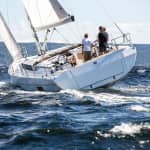
This unusual mix of materials for the production of the hull has become necessary because RM's longstanding in-house designer Marc Lombard has given the new ship an ultra-modern, but also rather aggressive design language. This design can no longer be realised in a technically sensible way using plywood as a construction material.
Towards the bow, in particular, the freeboard to the deck is once again obviously strongly drawn in over a kink. In this way, Lombard wants to maximise the volume of the front and still keep the deck area small. Ultimately, this should save weight and additionally stiffen the connection between the hull and deck. The visual appearance benefits from this. The RM 1180 therefore simply looks sensationally good, apparently taking its cue from the latest designs for the spectacular Imoca-class ocean racers.
RM 1180 really gets down to business
The RM 1180 is not a designated racer, but rather a performance cruiser with a focus on touring sailing. This conceptual mix is known as "fast cruising". This can be translated as follows: the focus is on comfortable travelling and living at sea without sacrificing sportiness, sailing pleasure and performance. This is neither new nor particularly exciting, but RM has implemented it skilfully and uncompromisingly as usual.
For the YACHT test, the most marvellous sailing conditions prevail in the bay of La Rochelle. Winds between 18 and 22 knots, plus a crisp, short and challenging wave pattern. On the other hand, the RM 1180 easily manages an average of 6.7 knots and, with an angle of 40 degrees to the true wind, runs at an excellent height. A large gennaker is hoisted up to the top of the mast for room-sheet courses. At 5 to sometimes even 6 Beaufort, it is really sporty, with the best daily performance in the surf being 13.4 knots. The performance potential is quite remarkable for a yacht of this type.
It should not go unmentioned that the test ship, the prototype, is equipped with a carbon fibre rig. The mast is slightly higher than the standard aluminium profile and therefore carries slightly more sail area. Because the upper and lower shrouds are separate, the genoa can be sheeted in between and tailored by the sailmaker to a maximum overlap of 110 per cent. Unfortunately, it is not possible to retrofit a self-tacking jib due to the large panoramic window in the cabin superstructure in front of the mast. The boat can be fitted with a stay jib and additional backstays on request for long trips on the high seas.
More width, more stability with the RM 1180
The boat from the new RM boss also has a fixed keel and double rudder blades, which are available as an option. As standard, the shipyard fits all boats in the current programme with bi-keels, i.e. two parallel fins and only one rudder blade. In this version, RM boats can easily fall dry. The rudder blade is fitted with a base plate to prevent it from sinking into the silt. With a swivelling keel as an additional variant, flexible draughts are also possible.
At the very rear, the RM 1180 is an impressive 4.16 metres wide, with a maximum extension of 4.37 metres. The layout of Marc Lombard's design is therefore almost wedge-shaped. This may be a disadvantage in the harbour when mooring astern.
Under sail, on the other hand, the enormous width in combination with the flat underwater hull has a noticeably more stable shape. This is particularly evident in the crisp gusts, which the RM 1180 converts into propulsion and speed even under full sail, instead of lying on its side. The boat sails extremely stiffly on the cross as well as on the downwind courses with a gennaker and, thanks to the perfectly tuned steering system and the double rudder blades, remains easy to control at all times, even at high speeds. Under sail: great class!
For the layout in the cockpit, RM continues to rely on the concept typical of the brand. This means that halyards and trim lines as well as the mainsheet run back over the cabin superstructure to the two winches on the companionway. Another two winches are available for the genoa and gennaker sheets. They are mounted on separate platforms and can be operated efficiently at a good height.
This arrangement also works with a small crew of two or three people. The high-quality deck fittings and the sufficiently large standard Lewmar winches also ensure smooth manoeuvres.
Somehow lost on the bike
However, the helmsman is quite isolated in his working area behind the wheel and cannot operate any other important components apart from the traveller and the backstay. Unfortunately, this makes the boat unsuitable for single-handed sailing. A German Cupper system with a double-guided mainsheet on two additional winches on the coaming is unfortunately only available as an option at extra cost; for a sporty boat of this type, such an arrangement would be desirable from the shipyard. The steering columns are also positioned quite far aft in the cockpit. The space for the helmsman is therefore limited and he constantly has the pulls of the double-guided backstay behind him. This can be annoying in the long run.
Instead of forecastle boxes, voluminous aft storage compartments are available. Additional sails such as a gennaker or code zero can also be stored in these. A separate, open storage compartment is provided in the stern for the liferaft; from there, the liferaft can be reached quickly in an emergency and launched without difficulty. Due to the enormous width aft, the stern railing must be split in accordance with the CE standard. The steel frame attached for this purpose offers welcome holding options when getting on and off the boat and when going for a swim. Folding stern platforms, on the other hand, have generally never been an issue for RM. The new boat is no different.
The RM 1180 is charming and stylish
If you go below deck through the beautifully wide companionway, you will experience a real wow effect. Spacious, bright, cosy and with the charm of a summer cottage in the west of France - this is how the interior presents itself at first glance. The large window areas in the superstructure and the windows in the hull offer the best view both standing and sitting.
Because RM Yachts produces the entire interior and the inner shells from plywood, the surfaces such as bulkheads, side and roof panelling, the doors to the cabins and the bathroom are always painted white; there are no alternatives. This is not the case for the galley and navigation work surfaces, which are coated in matt black on the test boat.
This looks good and provides attractive contrasts below deck. However, the black surfaces are very sensitive and require constant care and cleaning. A different choice of colour is always possible here.
RM 1180 has two identically sized aft cabins as standard
Everything that is visible and tangible below deck is made of either wood, fabric or steel. Plastic inside is generally a taboo at RM. And the workmanship is first-class, even down to the smallest detail. The shipyard only has some catching up to do when it comes to the floorboards. The test boat's floorboards, which were made from bamboo plywood, warped in the summer heat. Some of the edges are protruding and the panels creak under load. The problem has been recognised.
The three-cabin design with two identically sized aft cabins corresponds to the standard ex-shipyard on the RM 1180. This means that the company is now moving away from the principle of designing the boats with a walk-in stowage and technical room and dispensing with a second aft cabin. However, the workroom is still offered as an option and could even be retrofitted if desired. In any case, there will be only one wet room in the ship. The toilet room is relatively small and does not have a separate shower area, which is already a standard feature on comparably sized cruising boats.
More important for RM seems to be a large navigation system with an ergonomic seat and an extensive map table. Here you can work efficiently and safely while travelling. And thanks to the large panoramic window in front of the mast, it is even possible to look ahead in the direction of travel from the navigation area if you stand up briefly. The U-shaped galley is also easy to use at sea. The high, all-round rocker rails provide stability, and if the sea rises, you can wedge yourself in easily. The kitchen is also pleasing with its many, large and well organised storage compartments and large work surfaces.
Lack of storage space is not an issue on the RM 1180
The double berths forward and aft are large enough for two people with a width of over 1.50 metres at the shoulders. There is also plenty of space in the footwell. And there is plenty of storage space in all three cabins, in the form of cupboards or as open swallow nests for smaller items.
The two very small hatches in the coachroof are not sufficient for good ventilation in the saloon. If desired, additional windows that can be opened but are also very small can be retrofitted to the side, for example above the galley. However, these extras will not really make a decisive contribution to good ventilation. In contrast, the air can circulate much better in the cabins, where there are more and larger hatches.
Attractive price, expensive extras
The RM brand is not known for its extremely favourable pricing policy. Nevertheless, compared to the competition, the basic price for a new RM 1180 appears to be quite fair and competitively priced. If you also consider the high-quality basic equipment and the exclusive wooden construction, the offer could be described as quite attractive. However, interested parties should be aware that they will have to make an additional investment before the boat is ready to sail.
The fact that the hulls of the RM model generation are at least partly made of fibreglass raises questions. Why doesn't the shipyard produce the entire hulls in fibreglass composite and thus save costs? Why does it continue to rely on the complex, technically demanding and costly plywood construction method instead?
In response, RM Yachts cites the uniqueness of its concept, the well-known independence of the brand as well as the sustainability and better eco-balance of this type of yacht building. The environmental aspect in particular provides arguments for the purchase decision and can be marketed excellently - today more than ever.
How the material mix works


Only the sides of the hull of the new boat from RM Yachts are made of GRP; the special design leaves the shipyard no other choice in production. The rest, the entire underwater hull and the complete floor assembly are still made of plywood. The CNC-milled panels are put together like a jigsaw puzzle over a mallen frame and covered with a layer of fibreglass. "Of course it would be easier to build the entire hull from GRP," says RM project manager Maxime Védrenne. "But then the boat would no longer be an RM."
The measured values for testing the RM 1180


The RM 1180 in detail

Technical data and more
- Design engineer:Marc Lombard
- CE design category:A
- Torso length:11,80 m
- Width:4,37 m
- Tiefg. Bi keels/T keel:1,95/2,20 m
- Draught Swivelling keel:1,30-3,20 m
- Weight (Std. bi-keels):7,0 t
- Mainsail:47,0 m2
- Furling genoa (110 %):48,0 m2
- machine (Volvo P.):37.5 kW/51 hp
Hull and deck construction
Hull: GKF sandwich side panels. Underwater and structure: plywood. GRP deck built in vacuum infusion
Price and shipyard
- Base price ex shipyard: 336,700 € gross, sails incl.
- Guarantee: 2 years
As of 12/2023, how the prices shown are defined can be found here !
Shipyard and distribution
RM Yachts/Fora Marine; 17180 Périgny (France); www.rm-yachts.com
YACHT rating
Attractive combination for owners with high demands on touring and sporty sailing. The construction method with a synthesis of plywood and GRP is unique, as is the concept
Design and concept
- + Durable hull, modern shapes
- + Different keel variants
- - Little room for the helmsman
Sailing performance and trim
- + High dimensional stability
- - German-Cupper system only as an option
Living and finishing quality
- + Pretty, charming interior design
- + Impeccable workmanship, even in detail
- - Little ventilation in the lounge
Equipment and technology
- + Perfectly harmonised controls
- + High standard of equipment
- - Control without safety
This article first appeared in YACHT 20/2019 and has been updated for this online version.
This might also interest you:

Michael Good
Editor Test & Technology
