


The fact that Hanseyachts has awarded the design contract for a new, large ship to Studio Berret/Racoupeau in France is both surprising and astonishing. The yacht builders in Greifswald have always worked closely with the office of Judel/Vrolijk & Co for the development of the Hanse brand. All previous and current models originate from the designers in Bremerhaven. So why the switch to the French? Hanse press officer Morten Strauch explains the background to the new cooperation: "We organised a design competition for the new ship for the first time, and Berret/Racoupeau delivered the best and most suitable vision for us." In the press release that has now been published, Hanse also writes of a "starting signal for a new model series". Meaning: Hanse is probably planning a major generation change. Press officer Strauch was initially unable to reveal which models are planned for the further expansion of the programme, when they will be launched and whether the Berret/Racoupeau office will also be commissioned for the designs.
Nevertheless, the new ship should also be a true Hanse through and through, with the typical concept DNA. This means: handling that is as simple and clear as possible, even for the small crew, thanks to the standard self-tacking jib, many options for customisation on and below deck as well as in the fittings, exclusive detail solutions and good, sporty sailing characteristics. The new ship from Berret/Racoupeau stands out clearly from the current Hanse line from Judel/Vrolijk & Co, both visually and in terms of design. For example, the French-designed crack shows quite striking chines, which combine maximum hull volume with a nevertheless slim waterline and maximise space below deck. When looking at the construction drawings, an almost square floor plan can be recognised from the stern almost to the shrouds. This means that the boat is just as wide at the stern as it is at the centre of the ship, namely 4.79 metres. Nevertheless, the new model still has just one rudder blade.
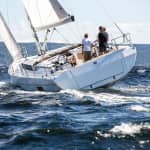
For the first time ever, Hanse is now producing a boat with a composite bowsprit permanently attached to the hull, including an integrated anchor bracket and attachment point for a gennaker or code zero. Typical for the shipyard: the self-tacking jib is still part of the basic equipment. A short overlapping genoa (105 per cent) as well as a larger genoa with 145 per cent overlap can be ordered as an alternative or additionally. The relatively high aluminium rig with two pairs of spreaders stands on deck and carries 106 square metres of sail area on the wind with a self-tacking jib. This corresponds to a sail carrying capacity of 4.5, which is quite sporty for a pure cruising boat. The cast iron L-keel is also available in two versions, with a draught of 2.25 metres or alternatively 1.75 metres.

All halyards, sheets and trim lines are led back below deck to the helm stations, where two large winches are available on each side. Here, the helmsman should be able to manage single-handedly without any problems. The bathing platform opens electrically and, together with the "wet bar" integrated at the stern, provides a welcome relaxation area. However, the concept does not include a stern garage for the dinghy. However, telescopic davits are available as an option. The two lowerable tables in the cockpit make it possible to convert the davits into nice wide sun loungers with additional cushions. The cockpit can also be at least partially covered with a hardtop and combined with a fixed windscreen. Solar panels for a self-sufficient power supply are available on top.
Customers are spoilt for choice when it comes to the interior fittings, with no fewer than 48 combinations of all possible variants. The three-cabin model with two spacious toilet rooms and fully separable shower cubicles is standard. A third bathroom can also be ordered on request. For use in yacht charters, there are also variants with four cabins and four heads or even five cabins, with the option of double berths or stacked Pullman beds. The layout variants can be seen in the picture gallery below. No layout variation is to be expected for the central saloon. The large U-shaped sofa and a long, side-mounted galley line, which promises large work surfaces and plenty of storage space, will be retained here.
The 460 is now under construction at Hanse in Greifswald and is scheduled for completion in September 2021. It is not yet clear whether the new boat will be on show at the major trade fair in Cannes. In any case, the plan is to present it at the boot trade fair in Düsseldorf in January 2022. The shipyard has also already quoted prices: the well-equipped basic version of the Hanse will cost 292,620 euros ex shipyard, including a single set of Dacron sails and 19 per cent VAT. This makes the new boat only slightly more expensive than the only slightly smaller Hanse 458 (262,870 euros), which Hanse intends to keep on offer for the time being.


Technical data Hanse 460
Comparison test of 45-foot touring yachts at YACHT tv, part 1
Comparison test of 45-foot touring yachts at YACHT tv, part 2
Downloads:

Michael Good
Editor Test & Technology
