


The cutter slowly pushes backwards towards the quay in Glückstadt's Elbe harbour. The gusty breeze grabs the elegant clipper bow and moves it to leeward, towards the outer jetty. If only that goes well. But with the help of the huge tiller, a few pushes on the throttle and a little support from outside, the ship is soon safely moored - and ready for the next trip with the next crew and the next guests, who are already standing on land chatting and laughing.
The handover of the ship runs like clockwork. It has to, because the "Rigmor von Glückstadt" is well booked: it sails around 65 times a year. For those interested, the "Rigmor" timetable once again offers various opportunities to sail on board this year. A three-hour short trip on the Elbe off Glückstadt costs 30 euros including coffee and cake. The evening trips are also very popular. Further information is available at www.rigmor.de. Sometimes longer trips are also sailed, for example for the Hamburg harbour birthday or the Kieler Woche.In mid-May, the "Rigmor" will set course for Flensburg again and take part in this year's Rum Regatta, which will take place from 18 to 21 May 2023.
The "Rigmor von Glückstadt" is a sought-after classic
The "Rigmor" continues to be lovingly maintained by the members of the "Förderverein der Rigmor von Glückstadt e. V." and, as a traditional ship flying the German flag, has a safety certificate from the BG Verkehr.
The training of club members who are actively involved in the operation of the ship is a high priority. Regular theoretical and practical training courses are offered to ensure the safe and organised operation of the ship.
The cutter was built as a customs cruiser at the Schröder shipyard in Glückstadt harbour ages ago: in 1853, when the Danes were still in charge in Schleswig-Holstein. Today, the operators proudly call the boat "Germany's oldest seaworthy sailing ship". What still survives? Traces of the former building fabric between the floor wings, but mainly: the spirit.
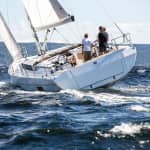
The oldest sailing ship in Germany- a classic for the people
Nevertheless, authenticity is a top priority: manual anchor capstans, leather-covered blocks, beaten cordage, neat splices and rigging, galvanised iron fittings and a gigantic, curved oak tiller mounted on a wooden rowing coker. Almost everything as it was back then. Even "Manila Billy", the name of the line that hangs ready to hand on the bulwark. "You need it to tame the tiller in case of chop and wave," explains one of the crew.
The classic is well painted, it is a prestige object. Not a private one, but a municipal one. The "Rigmor" is a ship for the people and a monument in honour of the region's maritime culture. Of course, many thousands in private donations have gone into it, but also considerable funds from the public purse.
The guests are now on board and put on life jackets. Under the skipper's command, the black ship chugs away in slack water and a good 5 Beaufort from the west. "Reef one and jib!" are the instructions to the crew. The imposing centreboards, the ship's trademark, remain up. What a pity. Since an iron wedge was bolted under the boat, they are no longer absolutely necessary.
The "Rigmor" used to be a customs cruiser
Nevertheless, "Rigmor" sails off at full speed, with foaming waves in front of her broad bow. She resolutely makes her way up the Elbe in the glistening sunlight. The sight gives an idea of what it might have been like in the past: when customs cruiser No. 5 was chasing smugglers with a flapping dannebrog, slamming a shot across their bows with the falconette in an attempt to stop them.
In 1864, after the Danes were defeated by Austria and Prussia, the ship was towed to Hamburg as a prize. A Dane named Gerret Jacob Matzen bought it at auction at a favourable price and converted it into the cargo ship "Treue". This marked the beginning of a new career for the cutter, which from then on appeared under various names in Denmark and Schleswig-Holstein. In 1917, a certain Christen Christensen took over the ship, which had meanwhile been downgraded to a stone fisherman, and named it after his daughter Rigmor. Equipped with an engine, loading crane and wheelhouse, "Rigmor" dredged boulders from the Baltic Sea or sand and gravel from shipping channels over the following decades. With her shallow draught, she was particularly popular in small, shallow harbours. And because she earned her owners money, she was also kept in reasonable condition.
The classic was rediscovered 45 years ago by Joachim Kaiser. He is now on the board of the Hamburg Maritime Foundation and was travelling on the Baltic Sea with a youth cutter at the time. During a stay on Falster, he filmed and photographed the dredger, and the shape of the hull revealed its past as a sailing ship.
The classic is rediscovered- and the project
But it wasn't until decades later that Kaiser began his research, and the more he learnt about the ship, the more he wanted to know. "It was detective work and took a lot of perseverance," he says, looking back on his research. It took him through countless archives and collections, sometimes leading to dead ends and often only getting back on course by chance. Nevertheless, in the end the puzzle was put together.
It was quite another feat to convince the grandees of Glückstadt that this "Rigmor" symbolised the town's maritime tradition and would therefore be a worthy restoration project. Only when this was achieved could the purchase be made. 150,000 crowns, the equivalent of a good 20,000 euros, had to be raised for the pack of old, dilapidated planks. And that was just the beginning. After being transferred from Denmark to Glückstadt in autumn 1992, it would take eight years before the ship was restored to its original condition.
The restoration work costs time and money
The hull had to be torn open before it could be stripped at the Dawartz shipyard in Tönning - which was more reminiscent of archaeological excavation work than boat building. Among other things, bronze keel bolts were found, which presumably came from the original construction.
On 21 October 1995, the restored hull was ceremoniously launched and it was thought that the ship was already on the home straight. However, it was a long time coming and it took another six years until completion.
There were real dry spells," says Kaiser, who also remembers sometimes having to requisition material "almost to the point of theft" "so that the boys had something between their fingers". Supporters who were liable to the bank began to ask questions. In addition to the obligatory appeals for donations, art projects were organised with the help of well-known painters such as Hinnerk Bodendieck, Uwe Lütgen, Kurt Schmischke and Hans-Peter Wirsing, the proceeds from the sale of which went towards the restoration work.
Grants and donations helped to advance the classic project
However, the decisive impetus came in 1998, when Federal Chancellor Gerhard Schröder promised money for 100,000 training places to combat youth unemployment. This increased the chances of the restoration being finalised as a job creation measure. Kaiser had the application ready in the drawer, it just had to be calculated and submitted. The project was scheduled to run for two years, with 25 participants and nine trainers.
Kaiser also found a supporter in Ulrich Grobe at the Elmshorn Chamber of Industry and Commerce. Mayor Brigitte Fronzek supported the partial assumption of the project costs and approved a building site at the harbour. It was a container castle that was somewhat cheekily named the "Elmshorn Museum Shipyard". There, "Rigmor" was given the expensive finishing touches, meticulously modelled on historical models.
For operation with passengers, not only did a galley have to be installed in the bow, but also a toilet with waste water tank aft. In the engine room right next door, a restored 63 hp Bukh diesel roars when sailing has a break.
The classic "Rigmor" sails again at the turn of the millennium
Further funding came from the German Foundation for Monument Protection and the State Office for Monument Preservation. The ship was registered with the state of Schleswig-Holstein as a technical monument and was therefore considered eligible for funding. But money never comes for free. Loans had to be paid off at the bank and construction deadlines had to be met. The partial renovation of the stem that had become necessary and the external ballast required by Germanischer Lloyd to improve stability delayed and increased the cost of the project. But with combined forces, the work continued undaunted so that the "Rigmor" could be put into service ready to sail on 27 October 2000 - modelled on the original down to the last detail.
Meanwhile, out on the Elbe, the current has capsized and we are now heading against it. The skipper gives the "Rigmor" the spurs, so that the water under the clipper bow hisses and gurgles. This goes down well with the guests. "I'm absolutely thrilled," says Andreas Pätzmann from Hamburg. He booked the trip as a birthday present for Rainer Rathje, who sails on the Alster Centaur dinghy. "It's like being on a giant dinghy," says Rathje about the feeling of sailing on this floating monument.
All too soon, the skipper gives the order to hoist the sails - the hard crossing against choppy seas ranks low on the list of priorities. The ship turns back to Glückstadt, where the history of this ship once began, back in 1853.
This article first appeared in YACHT 9/2015.
Technical data "Rigmor von Glückstadt"

- Lüa (incl. bowsprit): 21,25 m
- Hull length: 15.90 m
- Width: 3.85 m
- Draught: 1.45 m
- Sail area: 129.0 m²
- Engine: Bukh diesel, 63 hp
